How to Practice Between Online Violin Lessons for Faster Improvement
- The Expressive Violinist
- May 14
- 6 min read

One of the biggest misconceptions violin students have is that improvement happens primarily during the lesson itself. In reality, the lesson is only the beginning. The real progress happens during the days between lessons, when students take ideas, corrections, and technical concepts and turn them into consistent habits through focused practice.
This becomes especially important in online violin lessons. Because the teacher is not physically present throughout the week, students must learn how to practice with greater awareness and responsibility. Serious students quickly discover that online violin lessons are incredibly effective when the practice between lessons is structured correctly. Students who improve rapidly are usually not practicing randomly or relying only on repetition. They are practicing with intention, organization, and a strong focus on fundamentals.
Faster improvement on the violin rarely comes from chasing harder repertoire too quickly. More often, it comes from strengthening the foundation underneath the playing. Students who commit themselves to rebuilding hand position, refining the bow arm, improving facility, and maintaining a serious diet of scales and etudes often progress much faster than students who spend all of their time simply trying to play through pieces.
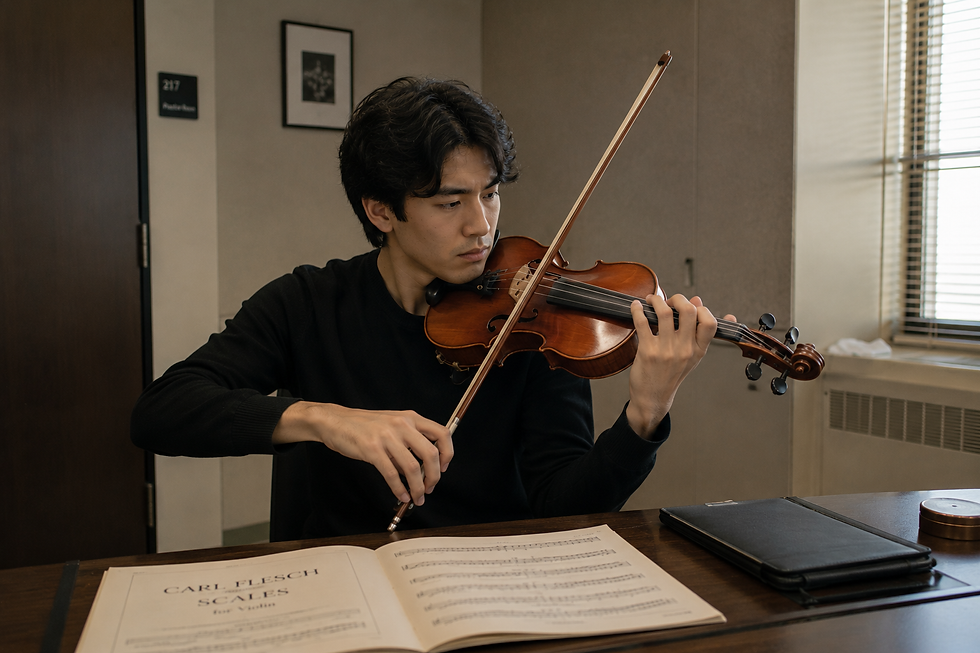
Faster Progress Begins With Fixing the Foundation
Many students want faster results, but very few initially want to return to fundamentals. This is understandable because fundamentals are not always glamorous. Students are often more excited by concertos, show pieces, and orchestra repertoire than they are by rebuilding a hand frame or refining basic bow motion. However, advanced playing is impossible without an advanced foundation.
When students plateau, the issue is often not musical understanding or effort. It is usually that basic technical problems are quietly limiting everything else. An unstable left hand affects intonation and shifting. A tense bow arm affects tone production and articulation. Weak facility limits fluency and consistency. These issues eventually appear in every area of playing no matter how advanced the repertoire becomes.
This is why strong online violin lessons often spend significant time addressing fundamentals even with advanced students. Great teachers understand that fixing the root of the problem creates much faster long term improvement than constantly treating symptoms in repertoire.
Students are often surprised by how quickly difficult passages improve once the underlying technical issue is corrected.
Hand Position Shapes Everything
One of the most important areas students should focus on between online violin lessons is left hand organization. The position and balance of the hand directly affect intonation, shifting, vibrato, finger speed, and overall facility. Even small inefficiencies in hand position can create major limitations over time.
Many students unknowingly practice with excess tension or collapsed structure in the left hand. They may squeeze the neck, flatten fingers unnecessarily, or create instability in the thumb position. These habits make advanced playing significantly harder than it needs to be.
Practicing slowly and carefully while observing hand balance can dramatically accelerate progress. This is especially effective when students isolate technical work instead of trying to solve these problems only inside difficult repertoire. Exercises that focus specifically on finger articulation, shifting patterns, and relaxed movement often produce much faster improvement than repeatedly struggling through passages at full speed.
Online violin lessons can be particularly valuable here because teachers often observe technical details very closely and can identify patterns students may not recognize on their own.
Bow Arm Fundamentals Must Be Reinforced Constantly
Students frequently underestimate how important the bow arm is to overall violin playing. The left hand often receives more attention because notes and shifts feel more obvious, but the bow arm controls tone, articulation, rhythm, clarity, and musical expression. Problems in the bow arm affect virtually every aspect of playing.
One reason students plateau is that they stop refining basic bow mechanics once they begin more advanced repertoire. Over time, tension accumulates, sound quality becomes inconsistent, and articulation loses clarity. Students may continue improving musically while their physical efficiency quietly declines underneath the surface.
This is why practicing open strings, bow distribution exercises, string crossings, and slow bow work remains important even for advanced players. Many orchestral professionals continue practicing these fundamentals throughout their careers because the quality of the bow arm directly affects the overall level of playing.
Between online violin lessons, students should spend regular time focusing purely on sound production and ease of movement in the bow arm. This kind of focused technical work often produces faster overall progress than simply practicing repertoire for longer hours.
Facility Is Built Through Repetition of the Right Material
Students often want greater facility, speed, and fluency, but these skills do not appear automatically through repertoire alone. Facility is usually built systematically through scales, arpeggios, and etudes that train coordination progressively over time.
This is one of the reasons serious violin training has traditionally relied so heavily on technical studies. Scales develop fingerboard understanding and intonation. Etudes train coordination, articulation, shifting, and rhythmic stability in a focused environment. Technical exercises isolate specific weaknesses in a way repertoire often cannot.
Students who maintain a strong technical diet frequently improve faster because they are strengthening the core mechanics required for advanced playing. Instead of constantly reacting to difficult passages, they are proactively building the technical ability necessary to handle those passages more naturally.
A student who works consistently through scales, Schradieck, Sevcik, Kreutzer, Fiorillo, or other technical studies often develops a level of comfort and reliability that eventually makes repertoire much easier to learn.
Slow Practice Creates Fast Progress
One of the most important habits students can develop between online violin lessons is slow practice. Ironically, students who rush to play fast often progress more slowly because they reinforce tension and inconsistency. Students who practice carefully and progressively usually develop speed much more reliably over time.
Slow practice allows students to observe details clearly. Intonation becomes easier to evaluate. Hand motion becomes more organized. Bow changes become smoother. Shifts become more predictable. Students also learn how to remain physically relaxed while playing difficult material.
This process builds security. Once movements become balanced and consistent at slower tempos, speed can be added gradually without sacrificing control.
Many advanced players eventually realize that slow practice is not a beginner tool. It is one of the most sophisticated forms of practice available because it develops awareness rather than merely testing reflexes.
Online Violin Lessons Encourage More Independent Practice
One major advantage of online violin lessons is that students often become more independent learners. Because much of the work happens between lessons, students gradually learn how to observe themselves more carefully and solve problems with greater awareness.
Strong online teachers encourage students to think analytically during practice rather than simply repeating instructions mechanically. Over time, students become more capable of organizing their own work, evaluating their own playing, and understanding how technical concepts connect together.
This independence becomes incredibly valuable long term because serious violin study ultimately depends on the student’s ability to practice intelligently without constant supervision.
Students who develop this level of awareness often continue improving steadily for many years.
Final Thought
Faster improvement on the violin rarely comes from shortcuts. It usually comes from returning to the fundamentals with greater seriousness and consistency. Students who focus on rebuilding hand position, refining the bow arm, strengthening facility, and maintaining a disciplined routine of scales and etudes often experience the most meaningful long term growth.
Online violin lessons can be highly effective for this process because they encourage focused listening, analytical practice, and structured technical development. Students are no longer limited by geography and can work with teachers who understand how to guide serious long term progress.
In the end, the students who improve the fastest are usually not the ones searching constantly for new tricks. They are the ones willing to build the foundation correctly and patiently over time.
FAQ: Practicing Between Online Violin Lessons
How can students improve faster between online violin lessons? Students improve faster by focusing on fundamentals, practicing analytically, maintaining consistent technical work, and developing organized routines between lessons.
Why are scales and etudes important for violin improvement? Scales and etudes build intonation, facility, coordination, rhythm, and technical consistency, which support all advanced repertoire.
Should advanced students still practice basic bow exercises? Yes. Bow arm fundamentals remain essential at every level because they directly affect tone quality, articulation, and musical control.
Why is slow practice effective? Slow practice develops accuracy, relaxation, awareness, and reliable coordination before speed is added gradually.
Can online violin lessons help advanced students improve efficiently? Absolutely. Strong online violin lessons provide detailed feedback, structured guidance, and access to specialized instruction regardless of location.
Work With a Teacher Who Expects More
Lyceum Academy for Violin works with highly motivated students to elevate their playing and achieve their musical goals.
Schedule a FREE complimentary lesson & discovery session to determine if our Academy is a good fit, or submit an audition video here for placement consideration.
For general questions, contact us: theexpressiveviolinist@gmail.com


Comments